Rubber & tires
- Process role: Co-activator with ZnO; processing/lubricity aid depending on formulation
- Critical parameters: C18/C16; acid value; iodine value; titer; ash; color

Stearic acid (octadecanoic acid) is a C18 saturated fatty acid. Commercial 'stearic acid' is often a controlled C18/C16 fatty-acid blend rather than chemically pure C18 material, so procurement should be based on composition and functional tests - especially acid value, iodine value, titer, color and moisture - not on the product name alone.
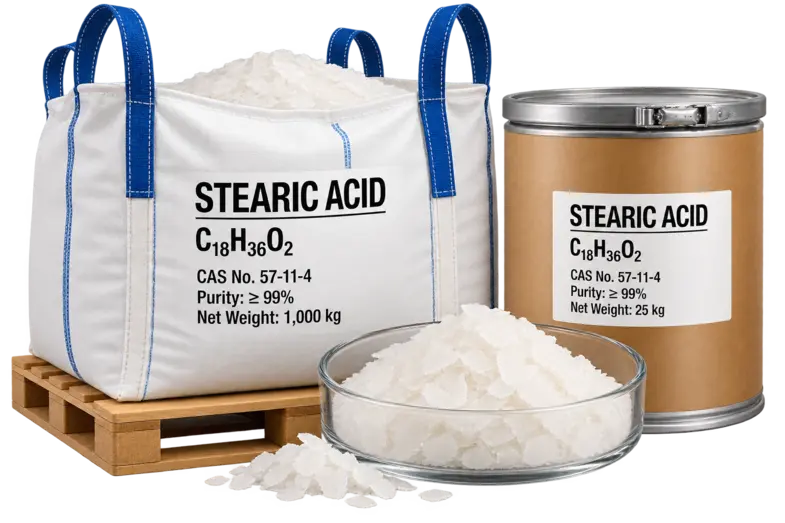
Stearic acid is a long-chain saturated monocarboxylic acid. Commercial material is commonly produced by hydrolysis/splitting of fats or oils followed by hydrogenation and fractionation. In rubber compounding it is particularly important as a co-activator with zinc oxide: zinc stearate species formed in situ participate in sulfur-vulcanization activation and can also influence processing, dispersion and lubrication. This functional role should be stated explicitly for tire and rubber buyers.
| Property | Value |
|---|---|
Formula |
C₁₈H₃₆O₂ |
CAS |
57-11-4 |
Molar mass |
284.48 g/mol |
Appearance |
White waxy solid, flakes, beads or powder depending on grade |
Melting point |
~69.3°C for pure stearic acid; commercial grades show grade-dependent titer/melting range |
Density |
~0.94 g/cm³ at 20°C (reference) |
Solubility |
Practically insoluble in water; soluble in many organic solvents |
Key commercial distinction |
C18/C16 distribution varies by grade |
Typical supply forms |
Flakes, beads/prills, powder; 25 kg bags are common but supplier-specific |
Acid value is determined through titration to verify available carboxylic acid content and maintain grade consistency. Iodine value is measured using validated titration methods to assess residual unsaturation and oxidative stability. Titer or solidification point is evaluated through standard producer methods to confirm thermal behavior and grade identity.
The C18 and C16 fatty-acid profile is analyzed using gas chromatography (GC) to ensure functional grade and batch consistency. Moisture and volatile matter are measured through gravimetric analysis or Karl Fischer titration, as applicable, to support proper storage and processing. Color is evaluated using Lovibond, APHA, or validated producer methods for appearance-sensitive applications. Ash and inorganic residue are determined through gravimetric testing to identify impurities and maintain contamination control.
Stearic acid is comparatively low-hazard under normal industrial use, but molten material can cause thermal burns and fine powder can create nuisance-dust exposure. Use good ventilation, housekeeping, eye protection and gloves appropriate to the physical form and temperature. For food, cosmetic or pharmaceutical use, hygiene and contamination-control requirements are as important as conventional HSE.
Common industrial packs include lined 25 kg bags, cartons or other producer-specific formats. For GCC/MENA supply, confirm physical form (flakes/prills/powder), palletization, liner, warehouse temperature, protection from contamination and lot traceability.
No. Many commercial grades are mixtures rich in stearic and palmitic acids; the fatty-acid profile must be specified.
It works with ZnO in the vulcanization-activation system and can also affect processing and dispersion.
For many industrial grades: fatty-acid profile, acid value, iodine value, titer, color, moisture and ash.
Not by assumption. The intended sector requires the appropriate grade, impurity limits and documentation.
Our team is ready to help you choose
the right grade for your application.