Municipal / industrial water
- Process role: Disinfection and oxidation
- Critical parameters: Available chlorine; certification where required; chlorate/bromate context; dosing system

Commercial sodium hypochlorite is procured primarily as an aqueous alkaline solution, not as an anhydrous solid commodity. The decisive buying parameters are available/active chlorine, NaOH excess, density, chlorate/metal impurities where relevant, production age, storage temperature, packaging compatibility and delivery frequency because hypochlorite continuously decomposes during storage.
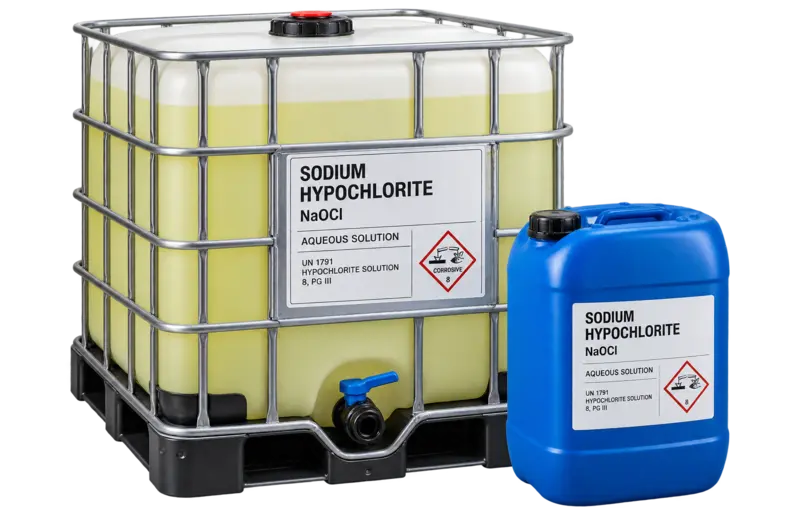
In water, hypochlorous acid/hypochlorite speciation is strongly pH-dependent. Commercial sodium hypochlorite is intentionally alkaline to improve stability. Its useful oxidizing/disinfecting capacity is expressed as available or active chlorine, which must be defined unambiguously in the RFQ. Concentration alone is insufficient if the analytical basis and age of product are unknown.
| Property | Value |
|---|---|
Formula |
NaOCl |
CAS |
7681-52-9 |
Molar mass |
74.44 g/mol |
Commercial form |
Aqueous alkaline solution; concentration is supplier/application specific |
Appearance |
Clear to pale yellow/green liquid; chlorine-like odor |
Reference density |
~1.21 for ~14% solution (concentration-dependent) |
Key assay basis |
Available/active chlorine; specify units explicitly: wt%, g/L or trade strength |
Stability |
Decomposes over time; accelerated by heat, light, lower pH and catalytic metal contamination |
Packaging |
Compatible vented HDPE/FRP systems, drums/IBCs/bulk as approved by supplier; concentration and route dependent |
Available or active chlorine is measured using iodometric titration or a validated producer method to verify the product's primary active content. Free NaOH and alkalinity are determined through acid-base titration to assess stability and process compatibility. Density and specific gravity are checked using a hydrometer or density meter for quick concentration verification during receiving inspection.
Chlorate levels are monitored through ion chromatography or validated methods to control aging and by-product formation, particularly for water treatment applications. Transition metals are analyzed using ICP or AAS when required to help control product decomposition. Appearance and suspended matter are evaluated through visual inspection or turbidity testing to identify contamination and assess product condition. Manufacture and filling dates are verified through batch documentation to manage shelf life and ensure the required active strength upon delivery.
Sodium hypochlorite solution is corrosive/irritant and a reactive oxidizing chlorine chemical. Prevent contact with acids, ammonia, reducing agents and incompatible metals. Provide ventilation, splash protection, chemical-resistant PPE, secondary containment and emergency eyewash/shower. Storage tanks and containers must be compatible and designed for gas evolution as specified by the supplier.
For industrial liquid supply, use supplier-approved drums, IBCs or bulk tanks/road tankers made from compatible materials. Confirm venting, UV/heat protection, fill concentration, delivered minimum active chlorine, maximum transport/storage time and receiving-tank compatibility. For potable-water use, require the applicable drinking-water treatment certification (for example NSF/ANSI/CAN 60 where contractually relevant).
We match the right grade to your process needs.
On-time delivery with strong regional & global logistics.
Strict quality control and batch consistency.
Technical & commercial support throughout your procurement journey.
Serving industries across GCC and MENA with local expertise.
No. It is one commercial concentration range; every order must state the required delivered active chlorine and analytical basis.
No. Standard industrial procurement is predominantly aqueous solution.
Available chlorine decays during storage, especially with heat, light and catalytic contamination.
Keep it away from acids and ammonia-containing chemicals; dangerous chlorine/chloramine gases can be released.
Our team is ready to help you choose
the right grade for your application.