Gold / silver recovery
Process Role:
Controlled cyanidation reagent
Critical Procurement / Engineering Parameters:
Active NaCN; physical form; certified supply/transport; site controls


Sodium cyanide is an acutely toxic, water-soluble cyanide salt used mainly in controlled gold/silver recovery and selected electroplating or chemical operations. It must be treated as a high-consequence dangerous good, not a conventional commodity reagent. Authorized supply should verify end use, receiving-site readiness, secure dry storage, emergency capability, certified transport and the applicable cyanide-management framework before shipment.
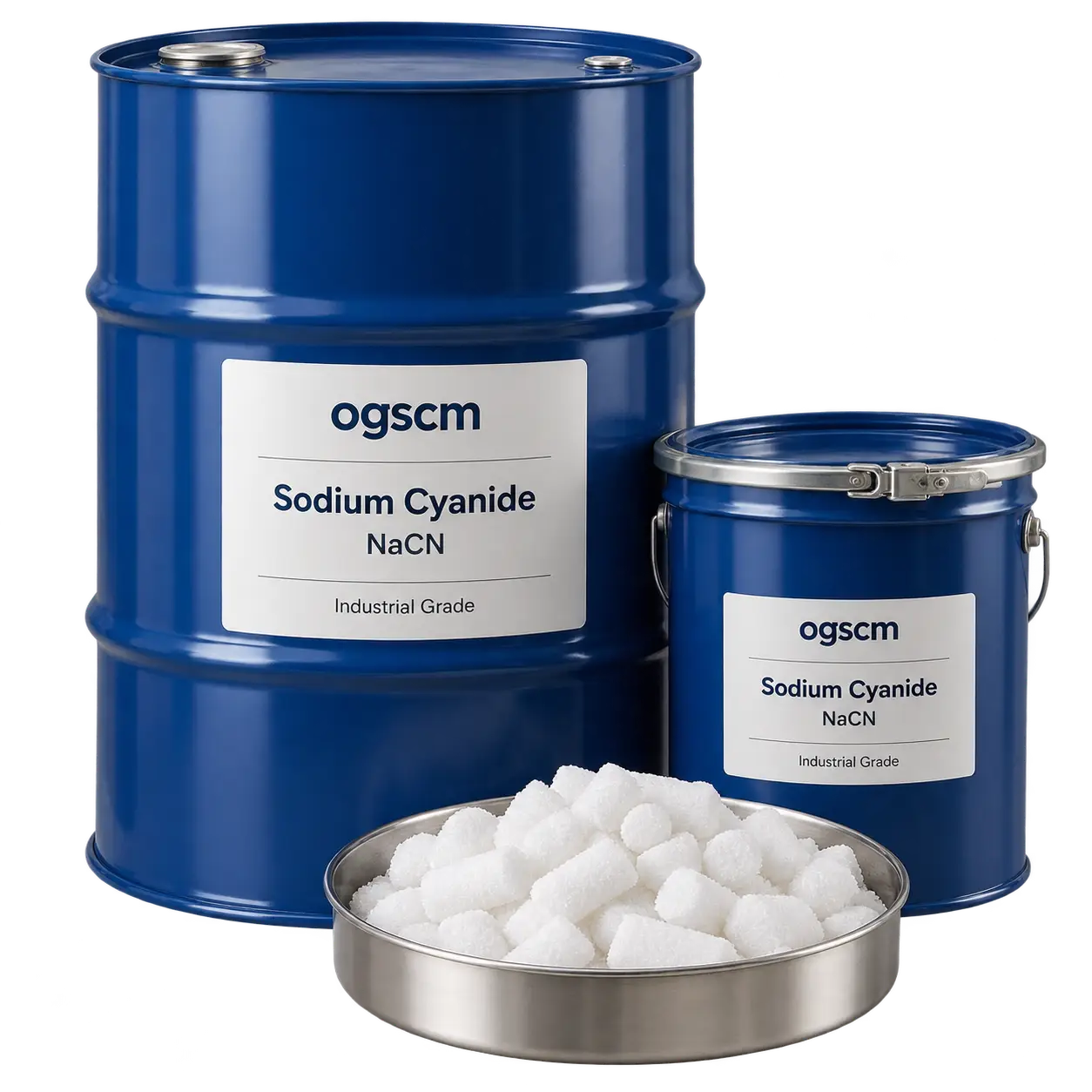
Sodium cyanide consists of Na⁺ and CN⁻ ions and is manufactured industrially by closed-process reaction of hydrogen cyanide with sodium hydroxide followed by concentration and solidification into briquettes or granules. The critical chemistry is acid-base controlled: cyanide solutions are kept strongly alkaline to suppress volatile hydrogen cyanide (HCN). Acids, acid salts, carbon dioxide and moisture/water can create HCN-release hazards, particularly when local pH is reduced.
| Property | Value |
|---|---|
Formula / CAS | NaCN / 143-33-9 |
Molar mass | 49.007 g/mol |
Appearance | White crystalline/granular solid; commercial briquettes/granules are common |
Density | ~1.595 g/cm³ at 20°C |
Melting point | ~563°C |
Water solubility | ~480-520 g/L at 20°C reference range |
Solution behaviour | Strongly alkaline; HCN release risk rises sharply if pH is lowered |
Commercial mining grade | Often ~98%+ active NaCN; producer-specific |
Transport | UN 1689 solid, Class 6.1, Packing Group I |
Engineering note
Values shown are reference or typical data, not a sales specification. Final acceptance must be based on the offered manufacturer grade, analytical method, COA, SDS and buyer specification.
Process Role:
Controlled cyanidation reagent
Critical Procurement / Engineering Parameters:
Active NaCN; physical form; certified supply/transport; site controls
Process Role:
Complexing / deposition chemistry in selected baths
Critical Procurement / Engineering Parameters:
Bath specification; purity; closed handling
Process Role:
Cyanide intermediate in authorized processes
Critical Procurement / Engineering Parameters:
Assay; impurity profile; controlled receiving system
Sodium cyanide can be rapidly fatal by inhalation, ingestion or significant skin exposure and can release highly toxic, flammable HCN gas under incompatible conditions. Storage must be dry, secure and segregated from acids, acid salts, oxidizers and other incompatible chemicals. Emergency procedures, gas-monitoring strategy where appropriate, competent responders and medical readiness must be established before receipt. No website text can substitute for the SDS, Cyanide Code guidance or site emergency plan.
HSE control principle
Use the current product-specific SDS, destination regulations, receiving-site risk assessment and applicable engineering standards. Website text must never substitute for an SDS, process safety review or site procedure.
Packaging is supplier- and mine-system specific. Available packaging includes 50 kg drums and 1,000 kg wooden boxes. Solid NaCN is UN 1689, Class 6.1, Packing Group I; dangerous-goods documentation, security and route controls are essential.
RFQ Specification Checklist
We match the right grade to your process needs.
On-time delivery with strong regional & global logistics.
Strict quality control and batch consistency.
Technical & commercial support throughout your procurement journey.
Serving industries across GCC and MENA with local expertise.
Yes. Its dominant industrial use is controlled gold/silver recovery, with smaller use in selected electroplating and chemical processes.
Lower pH shifts cyanide chemistry toward volatile HCN gas. Industrial systems therefore use controlled alkaline conditions and strict segregation from acids.
Sodium cyanide is available in 50 kg drums and 1,000 kg wooden boxes.
For gold/silver mining, the International Cyanide Management Code provides widely used principles and auditable standards for cyanide production, transport and use.
Our team is ready to help you choose
the right grade for your application.
