Supply for Boiler, Water Treatment and Oilfield Operations
Oxygen Scavengers are liquid chemical formulations used to reduce dissolved oxygen in industrial water systems. They are commonly applied in steam boilers, cooling and heating circuits, drilling fluids, water-injection programmes, and oil-and-gas operations, since dissolved oxygen in these systems can accelerate corrosion of metal equipment, pipelines, well components, and process infrastructure.
For industrial buyers, Oxygen Scavenger procurement needs to be aligned with the actual water chemistry, operating temperature, system pressure, metallurgy, injection point, dosing programme, and environmental requirements. Selecting an unsuitable chemistry or working from incomplete technical documentation can reduce treatment effectiveness and leave critical equipment exposed to oxygen-related corrosion.
OGSCM supports Oxygen Scavenger procurement through product-selection coordination, packaging planning, documentation readiness, and delivery support across GCC and MENA markets.
Oxygen Scavengers for Corrosion-Control Programmes
Oxygen dissolved in feedwater, cooling water, injection water, drilling fluids, or condensate systems can react with metal surfaces and accelerate corrosion. In steam-boiler systems, this can contribute to pitting, equipment damage, reduced operating reliability, and higher maintenance requirements. In drilling and oilfield injection operations, oxygen can affect wellbore equipment, pipelines, tanks, and associated infrastructure.
Oxygen Scavengers are formulated to react with dissolved oxygen in aqueous systems, and depending on the chemistry and system design, they may also support a wider corrosion-control programme. That said, an Oxygen Scavenger should not be treated as a complete corrosion-control solution on its own — treatment performance depends on the total water-treatment programme, dosing strategy, water quality, operating conditions, and equipment metallurgy.
Common Oxygen Scavenger chemistries may include:
Diethylhydroxylamine (DEHA)-based formulations
Carbohydrazide-based formulations
Sulphite-based formulations
The correct chemistry should be selected by the plant's technical, water-treatment, or oilfield chemical team based on the specific process requirement.
◎ Technical Specifications
Property
Value
Product Name
Oxygen Scavenger
Other Names
O₂ Scavenger, Boiler Oxygen Scavenger
Chemical Type
Aqueous oxygen-removal formulation
Common Chemistry Options
DEHA-based, Carbohydrazide-based, or Sulphite-based
Appearance
Liquid
Typical pH Range
6–8
Typical Density
1.185 g/cm³
Boiling Point
Approximately 100°C
Primary Function
Reaction with dissolved oxygen in water systems
Standard Packaging
IBCs or 220 L barrels
Documentation
COA and SDS/MSDS availability to be confirmed during RFQ
The listed physical properties are formulation-specific and should be confirmed for the actual offered product. Required active content, pH, density, dosage guidance, compatibility, residual limits, and handling requirements must be verified before supply.
Industrial Applications of Oxygen Scavengers
Steam Boilers and Condensate Systems
Oxygen Scavengers are used in boiler-water treatment programmes to reduce dissolved oxygen and help manage oxygen-related corrosion risks. Their role is to support the protection of boiler components, feedwater systems, condensate lines, and related equipment.
Effective performance depends on proper dosing, feedwater quality, deaeration performance, system pressure, temperature, and the full boiler-water treatment programme.
Heating and Cooling Water Systems
In heating and cooling circuits, Oxygen Scavengers may be used where dissolved oxygen contributes to corrosion risk. The treatment approach should be based on the system's operating regime, water chemistry, metal surfaces, and corrosion-control objectives.
Drilling and Oilfield Injection Operations
In drilling, hydraulic fracturing, saltwater-disposal injection, flooding, and related oilfield operations, oxygen can enter fluids during preparation, storage, transfer, or injection. Oxygen Scavengers may be used to reduce dissolved oxygen before or during these operations.
The correct formulation should be selected with regard to fluid chemistry, temperature, salinity, other additives, injection conditions, and environmental requirements.
Polymer and Drilling-Mud Systems
Oxygen Scavengers may be incorporated into selected polymer and drilling-fluid systems where oxygen control supports chemical stability or corrosion-management objectives. Compatibility with the full fluid formulation must be confirmed before use.
Industrial Water-Treatment Programmes
Oxygen Scavengers can support broader water-treatment programmes used in industrial plants, refineries, petrochemical facilities, and manufacturing operations. Their use should be coordinated with other treatment chemicals, monitoring practices, and site operating procedures.
Regulated Applications
Oxygen Scavengers may be used in specialised pharmaceutical, medical, or process-related applications only where the offered formulation is explicitly suitable and supported by the required technical and regulatory documentation. Such suitability must not be assumed from general industrial use.
Operational Positioning: Why Oxygen Control Matters
In boilers, cooling, drilling, and water-injection systems, dissolved oxygen creates a direct operational risk.
Oxygen-related corrosion can lead to equipment deterioration, unplanned maintenance, reduced asset life, leaks,
contamination, and process interruption.
In oilfield operations, oxygen may enter the system through makeup water, handling activities, injection operations,
or fluid preparation. In boiler systems, it may be introduced through feedwater or poor deaeration performance.
The right oxygen-control programme helps operators manage these risks as part of their wider water-treatment strategy.
Important procurement considerations include:
System type and operating conditions
Water source and dissolved-oxygen level
Required scavenger chemistry
Compatibility with the wider treatment programme
Injection point and dosing equipment
Storage-tank and transfer-equipment compatibility
Packaging, site consumption rate, and delivery schedule
COA, SDS/MSDS, and batch-documentation requirements
OGSCM supports procurement coordination around these practical requirements so that product selection
and delivery planning reflect actual operating conditions.
Packaging, Logistics and Delivery Planning
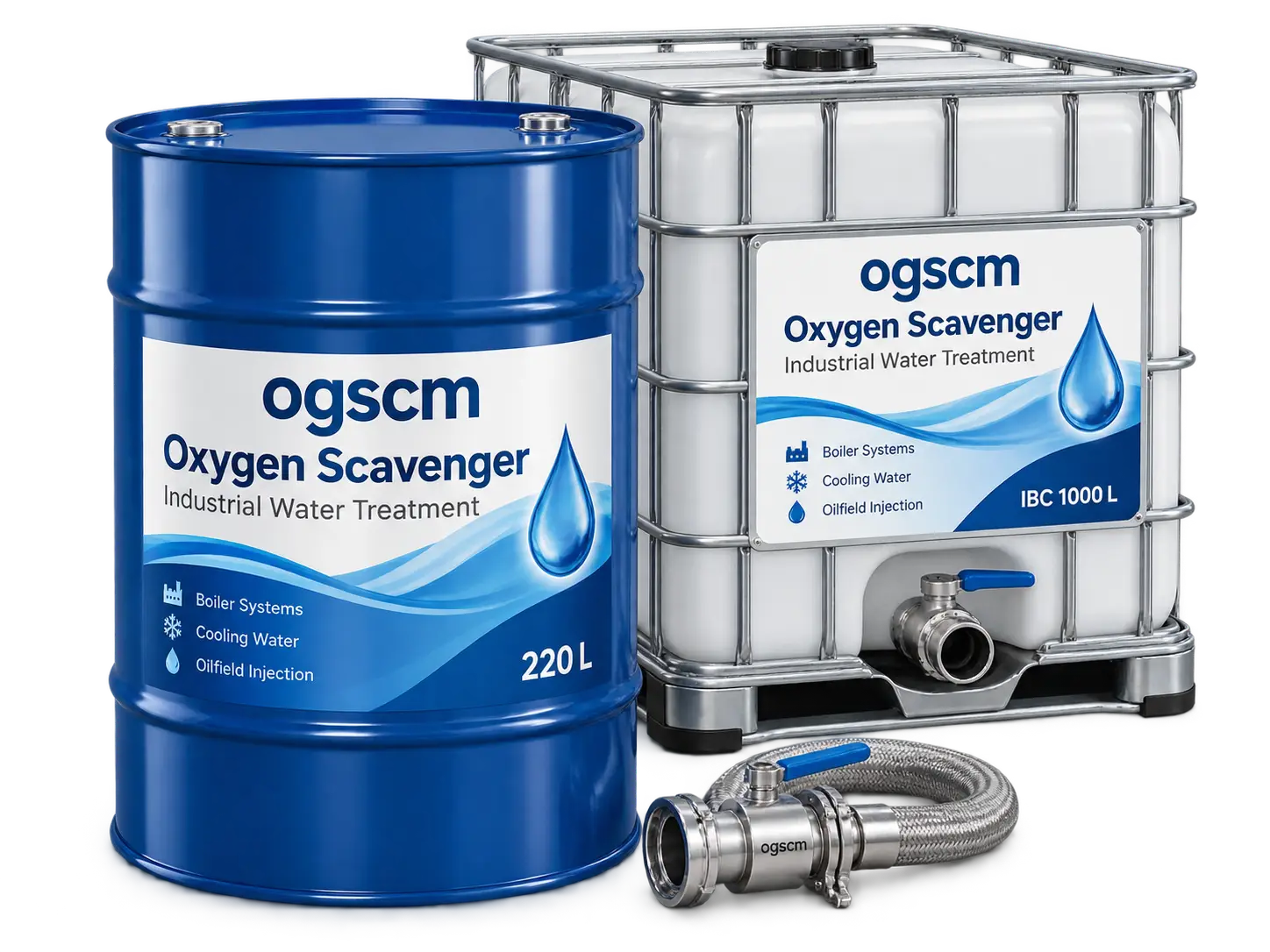
Oxygen Scavenger formulations can be supplied in:
220 L barrels
IBCs
The appropriate supply format should be chosen based on daily or monthly consumption,
storage capacity, dosing-system design, warehouse handling equipment, and delivery frequency.
Before shipment, buyers should assess:
Product chemistry and active-content requirement
Required quantity and dosing programme
Storage-tank, drum, or IBC capacity
Compatibility of pumps, hoses, seals, valves, and dosing systems
Receiving and batch-release procedure
Required technical documents
Site safety and spill-containment arrangements
Delivery timing relative to water-treatment or injection operations
OGSCM supports packaging and logistics coordination to help ensure that the material
is delivered in a format suitable for safe receiving and controlled dosing.
Oxygen Scavenger Procurement Across GCC and MENA
Across GCC and MENA, industrial water-treatment and oilfield operations may run continuously
or under planned injection and maintenance schedules. A supply interruption can affect
corrosion-control programmes, boiler-water chemistry, injection planning, and asset-protection measures.
OGSCM supports procurement through:
Chemistry and application alignment
IBC and barrel packaging coordination
Quantity and delivery planning
COA and SDS/MSDS documentation support
Batch and shipment-document coordination
Cross-border logistics planning
Receiving-site and storage readiness
Communication between procurement, water-treatment, operations, and logistics teams
Any destination-specific chemical, environmental, customs, or transport requirement
should be reviewed according to the actual formulation and delivery route.
Quality Verification and Documentation
For Oxygen Scavenger procurement, documentation supports product selection, safe receiving,
and treatment-programme control. Depending on the agreed supply scope, buyers may request:
Certificate of Analysis (COA)
Safety Data Sheet (SDS/MSDS)
Active-chemistry or product-specification confirmation
pH and density information
Batch or lot identification
Packing list
Commercial invoice
Certificate of origin, where required
Shipment documents aligned with agreed delivery terms
OGSCM does not assume a specific active concentration, approval, environmental profile,
corrosion-performance result, or system compatibility unless it is confirmed for the proposed formulation.
Safety, Storage and Environmental Considerations
Oxygen Scavenger formulations can vary significantly in their hazards. Depending on the chemistry,
they may be irritating, corrosive, reactive, or harmful to the environment, so the current SDS/MSDS
and site risk assessment must guide storage, transfer, use, spill response, and disposal.
Key operational considerations include:
Use suitable gloves, goggles, face protection, and protective clothing.
Maintain appropriate ventilation during handling and dosing.
Keep containers closed when not in use.
Store away from unsuitable heat, moisture, ignition sources, and incompatible materials, as specified by the SDS/MSDS.
Use compatible storage and dosing equipment.
Prevent release to drains, soil, and watercourses.
Manage empty containers, residues, and waste through approved site procedures.
Improper disposal of sulphite-, hydrazine-, or other scavenger-containing waste can affect water
quality and aquatic systems. Waste management must follow the actual product SDS/MSDS and applicable
environmental requirements.
Related Procurement Requirements
Oxygen Scavenger procurement may be connected to wider industrial supply needs, including:
Boiler-water treatment chemicals
Cooling-water treatment chemicals
Oilfield and drilling chemicals
Water-injection chemical programmes
Corrosion-control chemicals
Industrial liquid-chemical logistics
IBC and drum supply coordination
Procurement and supply-chain support
Why Choose OGSCM?
Application-Driven Solutions
We match the right grade to your process needs.
Reliable Supply Chain
On-time delivery with strong regional & global logistics.
Quality You Can Trust
Strict quality control and batch consistency.
Expert Support
Technical & commercial support throughout your procurement journey.
Regional Presence
Serving industries across GCC and MENA with local expertise.
Frequently Asked Questions
An Oxygen Scavenger is used to reduce dissolved oxygen in aqueous industrial systems, including boiler feedwater, condensate systems, cooling circuits, drilling fluids, and oilfield injection water.
Available formulations may be DEHA-based, Carbohydrazide-based, or Sulphite-based. The suitable chemistry depends on the system design, water chemistry, operating conditions, and treatment objective.
Based on the available product information, Oxygen Scavenger can be supplied in 220 L barrels or IBCs. The appropriate packaging format depends on consumption volume, storage capacity, and dosing-system requirements.
The RFQ should state the application, system type, required chemistry if known, quantity, packaging preference, delivery destination, requested documents, and relevant operating conditions such as temperature, salinity, or water source.
Buyers may request a COA, SDS/MSDS, product-specification details, pH and density information, batch identification, packing list, commercial invoice, certificate of origin where applicable, and shipment documents relevant to the agreed delivery terms.
Need Help Selecting the Right Oxygen Scavenger ?
Our team is ready to help you choose
the right grade for your application.