
Executive Industrial Overview
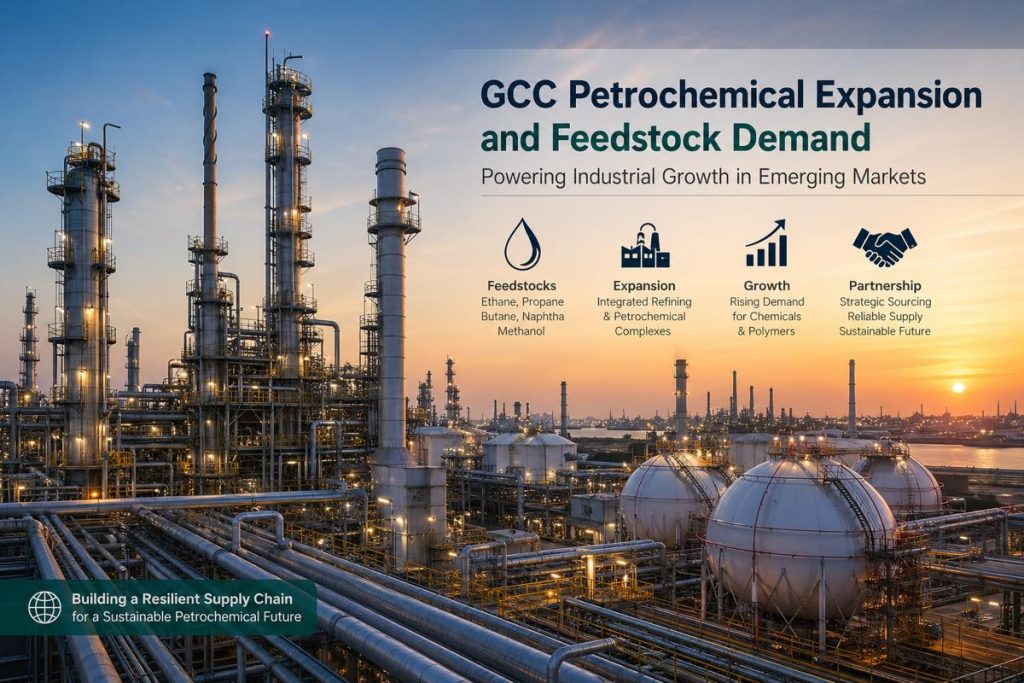
Countries such as Saudi Arabia, Oman, the United Arab Emirates, Qatar, and Kuwait are investing heavily in downstream petrochemical facilities to diversify their economies and enhance value creation. Initiatives like Saudi Arabia’s Vision 2030 and Oman Vision 2040 are accelerating the development of integrated refining and petrochemical complexes, leading to a substantial increase in feedstock demand.
As the region transitions from traditional commodity production toward higher-value specialty chemicals and advanced materials, the dynamics of feedstock sourcing are evolving. The growing need for ethane, propane, butane, naphtha, and methanol necessitates strategic procurement frameworks that ensure supply continuity, cost efficiency, and operational reliability.
OGSCM Group, with over …. years of specialized experience in chemical supply, catalysts, and technical integration for the oil, gas, refining, and petrochemical industries, supports stakeholders in navigating these dynamics through reliable sourcing, engineering expertise, and regional supply chain solutions.
Definition & Process Context
What Is Petrochemical Feedstock?
Petrochemical feedstocks are primary raw materials derived from natural gas or crude oil, serving as the foundational inputs for producing a wide range of petrochemical products. These include olefins, aromatics, polymers, and specialty chemicals used in industries such as packaging, construction, automotive, and electronics.
Ethane
Predominantly used for ethylene production.
Propane and Butane
Utilized in dehydrogenation and steam cracking processes.
Naphtha
A versatile feedstock for producing aromatics and olefins.
Methanol
Used in the production of formaldehyde, acetic acid, and various fuel applications.
How It Integrates into Industrial Operations
Feedstock selection and availability are integral to the design and operation of petrochemical plants. During the Front-End Engineering Design (FEED) and Engineering, Procurement, and Construction (EPC) phases, process licensors and engineering teams determine the optimal feedstock based on technology compatibility, cost considerations, and product objectives. Once operational, consistent feedstock supply ensures stable production rates, optimized yields, and efficient energy utilization.
Technical & Operational Considerations
1. Shift from Ethane to Liquid Feedstocks
Historically, the GCC petrochemical industry has relied heavily on ethane due to its cost advantages. However, increasing domestic demand and limited availability have prompted a shift toward liquid feedstocks such as naphtha and LPG. This transition enables greater product flexibility but also introduces new procurement and logistics complexities.
2. Integration of Refining and Petrochemical Operations
The development of crude-to-chemicals (C2C) complexes is transforming the regional petrochemical landscape. These integrated facilities maximize the conversion of crude oil into petrochemical products, significantly increasing feedstock demand and necessitating sophisticated supply chain strategies.
3. Technology and Process Flexibility
Modern petrochemical plants are designed with feedstock flexibility to adapt to market fluctuations. Technologies such as mixed-feed steam crackers allow operators to optimize production based on feedstock availability and pricing.
4. Infrastructure and Logistics Capabilities
The GCC benefits from advanced industrial infrastructure, including major hubs such as Jubail, Yanbu, Sohar, Ruwais, and Duqm. These clusters provide integrated logistics, storage, and pipeline networks that support efficient feedstock distribution and supply continuity.
5. Specialty Chemical and Additive Integration
As a knowledge-based supplier with strong R&D capabilities, OGSCM provides technical support for feedstock optimization, including compatibility studies for additives and processing aids that enhance yields and process efficiency.
6. Digital Integration and Supply Chain Visibility
Enterprise Resource Planning (ERP) systems and digital platforms enhance coordination and provide real-time visibility, enabling proactive decision-making in feedstock procurement and logistics.
Regional Regulatory or Market Factors
Government initiatives, localization programs, global market volatility, and sustainability priorities are shaping feedstock procurement across the GCC.
1. National Development Strategies
Government initiatives such as Saudi Vision 2030, Oman Vision 2040, and the UAE’s Operation 300bn are driving significant investments in petrochemical capacity. These strategies aim to enhance economic diversification and increase downstream value creation, thereby intensifying feedstock demand.
2. Localization Programs
Programs like IKTVA (In-Kingdom Total Value Add) in Saudi Arabia and ICV (In-Country Value) in Oman encourage the development of local supply chains and influence procurement strategies.
3. Global Market Dynamics
Feedstock availability and pricing are closely linked to global energy markets. Fluctuations in crude oil and natural gas prices, along with geopolitical developments, can significantly impact procurement strategies and project economics.
4. Sustainability and Energy Transition
The global shift toward sustainability and low-carbon energy is influencing feedstock selection. The GCC is increasingly investing in circular economy initiatives, carbon capture technologies, and clean hydrogen, which are expected to reshape future feedstock demand patterns.
5. Cross-Border Sourcing Expertise
Navigating complex regional dynamics requires experienced partners. OGSCM offers compliant, diversified sourcing channels that combine regional production strengths with reliable global and Omani supply options to ensure continuity.
Risk & Procurement Implications
1. Supply Continuity and Availability
The growing scale of petrochemical projects increases competition for feedstocks. Diversified sourcing and long-term supply agreements are essential to mitigating availability risks.
2. Price Volatility and Financial Exposure
Feedstock prices are subject to significant volatility. Flexible contracts and strategic planning help manage financial risks.
3. Logistics and Infrastructure Constraints
Strategic warehousing and integrated logistics planning enhance supply chain resilience despite potential bottlenecks.
4. Strategic Supplier Relationships
Long-term partnerships and performance-based contracts strengthen procurement efficiency and ensure consistent quality.
5. Technical Risk Mitigation
In-house R&D support provides compatibility testing, performance validation, and troubleshooting to minimize risks associated with feedstock variability or process changes.
Strategic Role of Industrial Partnership
The expansion of the GCC petrochemical sector necessitates collaboration with partners who possess both technical expertise and regional market intelligence.
OGSCM Group serves as a Strategic Industrial Project & Chemical Supply Partner. By integrating chemical engineering know-how with reliable sourcing, logistics, and R&D capabilities, we facilitate seamless coordination between feedstock requirements, engineering specifications, and regulatory needs. Such partnerships enable proactive risk management, efficient logistics, and long-term supply planning while supporting the sustainable growth and competitiveness of petrochemical industries across the GCC and broader MENA region.
Discuss Your Petrochemical Feedstock Requirements
Connect with OGSCM Group for reliable sourcing, technical support, logistics coordination, and long-term chemical supply planning.
Frequently Asked Questions
1. What are the primary petrochemical feedstocks used in the GCC?
The most common feedstocks include ethane, propane, butane, naphtha, and methanol, each serving specific roles in petrochemical production.
2. Why is the GCC shifting toward liquid feedstocks?
Limited ethane availability and the need for greater product flexibility are driving the transition toward liquid feedstocks such as naphtha and LPG.
3. How do national strategies like Vision 2030 impact feedstock demand?
These initiatives promote industrial diversification and downstream expansion, significantly increasing the demand for petrochemical feedstocks.
4. What risks are associated with feedstock procurement?
Key risks include supply shortages, price volatility, logistics disruptions, and regulatory changes. These can be mitigated through diversified sourcing and strategic partnerships.
5. How does sustainability influence future feedstock demand?
Investments in circular economy, carbon capture, and clean hydrogen are expected to reshape feedstock patterns and support low-carbon industrial systems.
6. What distinguishes OGSCM Group as a partner in feedstock supply?
We combine deep chemical and engineering expertise with reliable sourcing capabilities, delivering complete technical solutions from FEED support to operational optimization.
Executive Summary
The expansion of the petrochemical sector across the GCC is significantly increasing demand for diverse feedstocks, driven by national development strategies, technological advancements, and evolving market dynamics. The transition from ethane to more flexible liquid feedstocks, coupled with the emergence of crude-to-chemicals complexes, underscores the need for sophisticated procurement and logistics frameworks.
By adopting resilient sourcing strategies and fostering strategic industrial partnerships with experienced suppliers like OGSCM Group, organizations can effectively navigate supply and price volatility while ensuring operational continuity. As the GCC continues to strengthen its position as a global petrochemical hub, understanding feedstock demand dynamics — supported by specialized chemical expertise — will remain essential for sustaining long-term industrial growth and competitiveness.