Ethylene Dichloride (EDC) Production Process
Efficiently convert ethylene and chlorine into high-purity EDC that meets the stringent quality requirements of VCM cracking units.
EDC production units are typically integrated into large-scale chlor-alkali and PVC complexes.
Commercial EDC plants are designed for high on-stream factors, optimized energy consumption, and minimal environmental emissions.
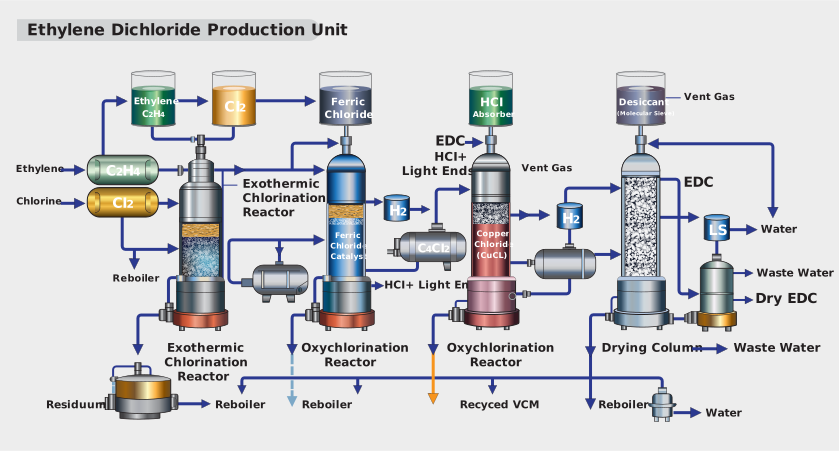
Ethylene Dichloride (EDC), also known as 1,2-Dichloroethane, is a key intermediate chemical widely produced in petrochemical complexes for downstream vinyl chloride monomer (VCM) and PVC manufacturing. The primary objective of the EDC production process is to efficiently convert ethylene and chlorine into high-purity EDC that meets the stringent quality requirements of VCM cracking units while ensuring safe, reliable, and cost-effective plant operation. EDC production units are typically integrated into large-scale chlor-alkali and PVC complexes and operate continuously under controlled conditions. Commercial EDC plants are designed for high on-stream factors, optimized energy consumption, and minimal environmental emissions.
EDC Production Routes
Ethylene reacts directly with chlorine in the presence of a catalyst to form EDC.
Ethylene reacts with hydrogen chloride (HCl) and oxygen to produce additional EDC.
Most modern plants operate a combined direct chlorination and oxychlorination configuration to maximize efficiency and raw material utilization.
A) Direct Chlorination
Direct chlorination is the primary industrial route for producing EDC. In this process, ethylene reacts directly with chlorine in the presence of a catalyst to form EDC.
Key commercial features:
- High conversion efficiency
- Continuous operation
- High product purity suitable for VCM production
- Integrated heat removal and recovery systems
This route is widely used in large-capacity EDC/VCM complexes due to its reliability and economic performance.
B) Oxychlorination
Oxychlorination complements direct chlorination by reacting ethylene with hydrogen chloride (HCl) and oxygen to produce additional EDC.
Commercial advantages:
- Recycles HCl generated in VCM cracking
- Reduces chlorine consumption
- Improves overall plant economics
- Supports closed chlorine balance
Most modern plants operate a combined direct chlorination and oxychlorination configuration to maximize efficiency and raw material utilization.
Catalysts
Catalysts play a key role in both direct chlorination and oxychlorination units by ensuring stable reaction performance and long operating cycles.
Copper-based catalysts for oxychlorination.
Supported metal catalysts for direct chlorination.
Catalysts play a key role in both direct chlorination and oxychlorination units by ensuring stable reaction performance and long operating cycles.
Common catalyst systems include:
- Copper-based catalysts for oxychlorination
- Supported metal catalysts for direct chlorination
Leading global catalyst and technology providers:
- Axens
- Lummus Technology
- ThyssenKrupp Uhde
- KBR
- Technip Energies
OGSCM Group supports petrochemical producers by sourcing and supplying refinery- and plant-approved catalysts with full technical documentation and logistics support.
Chemicals
Primary hydrocarbon feedstock.
Supplied from chlor-alkali units.
Recycled via oxychlorination.
Feedstock and Process Chemicals
EDC production units require a reliable supply of high-quality feedstock and process chemicals to maintain stable operation.
Key chemicals include:
- Ethylene (C₂H₄) – primary hydrocarbon feedstock
- Chlorine (Cl₂) – supplied from chlor-alkali units
- Hydrogen Chloride (HCl) – recycled via oxychlorination
- Oxygen / Air – used in oxychlorination reactors
- Caustic Soda (NaOH) – neutralization and purification
Standard Industrial Packaging and Supply Modes are Bulk pipeline transfer (ethylene, chlorine), ISO tanks and road tankers, IBC containers (1,000 L) and Steel drums (200–220 L). GSCM Group supplies EDC process chemicals in approved industrial packaging formats, ensuring compliance with plant safety standards and uninterrupted production.
Major Global Chemical Brands
EDC production chemicals and auxiliaries are typically sourced from internationally recognized suppliers.
Key global brands include:
- BASF
- Dow
- Olin
- Westlake
- Formosa Plastics
- INEOS
- Occidental Chemical (OxyChem)
OGSCM Group works with approved global manufacturers and regional suppliers to deliver consistent quality, competitive commercial terms, and full technical documentation.
Main Equipment
EDC reactors and vessels are designed for continuous operation under corrosive chlorine service and require specialized materials of construction.
Heat exchangers are used for reaction heat removal, condensation, and product cooling.
Reliable instrumentation is essential for safe and efficient EDC plant operation.
Reactors and Process Vessels
EDC reactors and vessels are designed for continuous operation under corrosive chlorine service and require specialized materials of construction.
Well-known manufacturers and suppliers:
- L&T Heavy Engineering
- Doosan Enerbility
- Mitsubishi Heavy Industries (MHI)
- ThyssenKrupp Industries India
- Technip-approved fabricators
OGSCM provides sourcing and supply solutions for EDC reactors, absorbers, strippers, and purification vessels, including internals, nozzles, linings, and associated mechanical components.
Heat Exchangers and Condensers
Heat exchangers are used for reaction heat removal, condensation, and product cooling.
Commercial suppliers include:
- Alfa Laval
- Kelvion
- API Heat Transfer
- Hisaka
- Tranter
OGSCM Group supplies heat exchangers and critical spare parts suitable for chlorine and EDC service.
Instrumentation
Reliable instrumentation is essential for safe and efficient EDC plant operation.
Major brands:
- Emerson
- Yokogawa
- Honeywell
- Endress+Hauser
- ABB
| Tag | Full Name | Function |
|---|---|---|
| PT | Pressure Transmitter | Reactor pressure control |
| TT | Temperature Transmitter | Reaction temperature monitoring |
| FT | Flow Transmitter | Feed and recycle control |
| LT | Level Transmitter | Liquid level management |
| AT | Analyzer Transmitter | Product purity monitoring |
Valves
Valves in EDC units must be suitable for chlorine and chlorinated hydrocarbon service.
Major manufacturers:
- Emerson (Fisher, Vanessa)
- Cameron (SLB)
- Flowserve
- L&T Valves
- Kitz
- Neway
OGSCM Group offers complete procurement solutions for isolation, control, and safety valves required in EDC production units, with full material traceability and technical documentation.
Submit Your RFQ
Contact OGSCM for EDC production catalysts, process chemicals, reactors, heat exchangers, instrumentation, industrial valves, and spare parts required for Ethylene Dichloride (EDC) production units.