Flat/container/solar glass
Process Role:
Flux and Na₂O source
Critical Procurement / Engineering Parameters:
Dense grade; assay; Fe; particle size/bulk density


Soda ash is anhydrous sodium carbonate supplied mainly as light and dense grades. The chemistry is the same, but bulk density and particle-size distribution are different enough to affect silo volume, dusting, conveying, dissolution and glass-batch segregation. Dense soda ash is commonly preferred for glass; light soda ash is widely used in detergents and chemical processing.
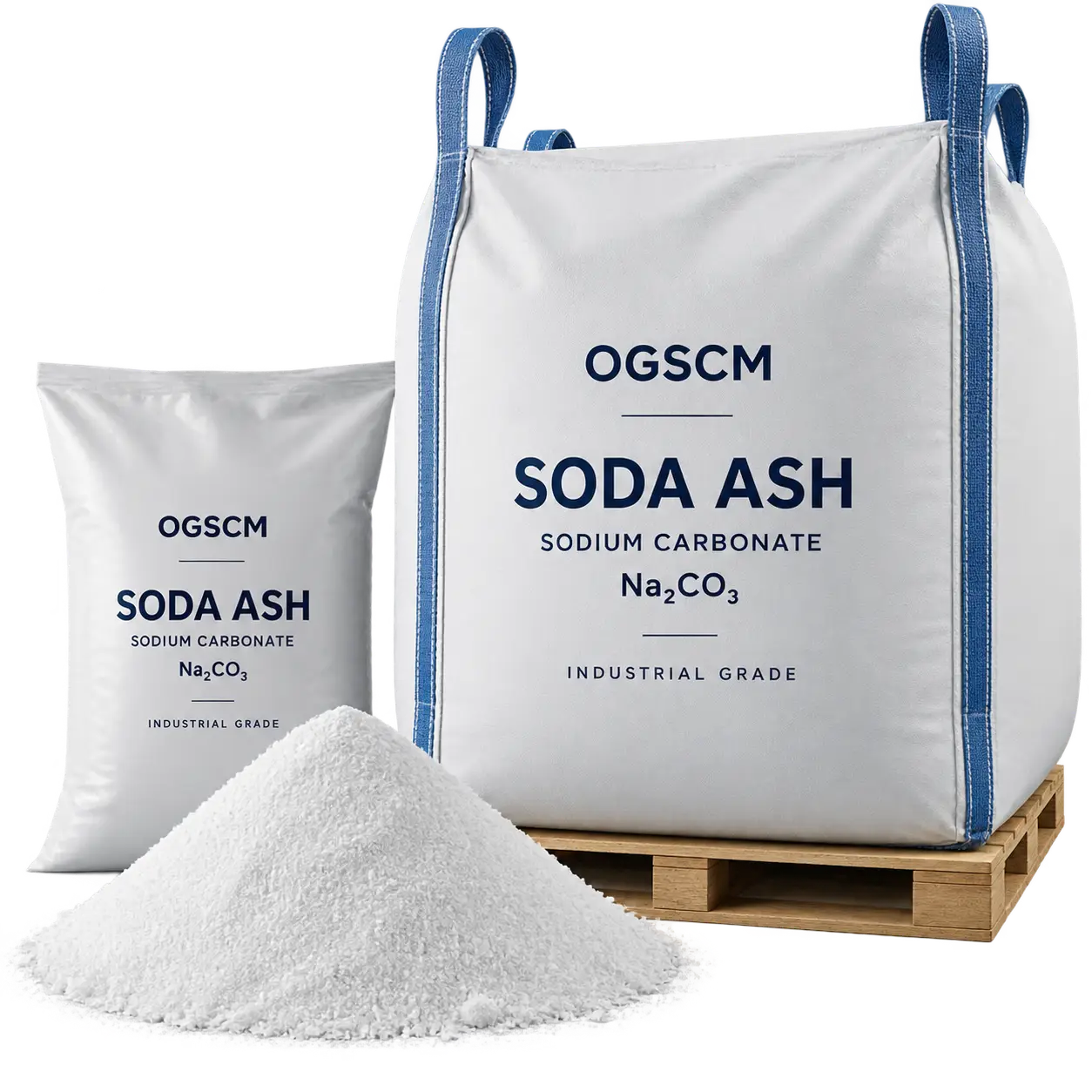
Soda ash may be produced synthetically by the Solvay (ammonia-soda) process or Hou process, or recovered from natural sodium-carbonate minerals such as trona and refined/calcined. Dense and light grades are not different molecules: processing changes particle structure and bulk density. In water, carbonate hydrolyses to generate an alkaline solution. With acids, sodium carbonate releases CO₂, which must be considered in closed equipment and neutralization systems.
| Property | Value |
|---|---|
Formula / CAS | Na₂CO₃ / 497-19-8 |
Molar mass | 105.988 g/mol |
Appearance | White anhydrous powder or granules |
True density | ~2.54 g/cm³ |
Melting point | ~851°C |
Water solubility | ~30.7 g per 100 g water at 25°C (reference) |
pH | ~11.3 for a 1% solution at 25°C (typical pure-material reference) |
Light bulk density | ~0.5-0.7 t/m³ typical; producer-specific |
Dense bulk density | ~1.0-1.1 t/m³ typical; producer-specific |
Transport | Generally not regulated as dangerous goods; confirm actual SDS |
Engineering note:
Values shown are reference or typical data, not a sales specification. Final acceptance must be based on the offered manufacturer grade, analytical method, COA, SDS and buyer specification.
Process Role:
Flux and Na₂O source
Critical Procurement / Engineering Parameters:
Dense grade; assay; Fe; particle size/bulk density
Process Role:
Alkalinity / builder chemistry
Critical Procurement / Engineering Parameters:
Light grade; bulk density; dissolution; chloride/sulfate
Process Role:
pH/alkalinity increase; softening/precipitation
Critical Procurement / Engineering Parameters:
Assay; insolubles; dosage chemistry
Process Role:
Sodium source and alkaline reactant
Critical Procurement / Engineering Parameters:
Na₂CO₃ assay; NaCl/Na₂SO₄; Fe
Process Role:
Alkaline conditions / dye fixation
Critical Procurement / Engineering Parameters:
Purity; dissolution; handling
Process Role:
Flux / precipitation chemistry in selected routes
Critical Procurement / Engineering Parameters:
Impurity profile; process qualification
Soda ash is lower hazard than strong caustic but its alkaline dust can irritate eyes, skin and the respiratory tract. Use dust-control measures, eye protection, gloves and appropriate respiratory protection where airborne dust is generated. Keep segregated from acids to prevent uncontrolled CO₂ evolution. Use the current grade-specific SDS for final classification and PPE.
HSE control principle
Use the current product-specific SDS, destination regulations, receiving-site risk assessment and applicable engineering standards. Website text must never substitute for an SDS, process safety review or site procedure.
Common formats include 25–50 kg lined PP/HDPE bags, one-ton FIBCs and bulk pneumatic
or shipload supply. GCC/MENA logistics should account for high humidity, pallet protection,
container condensation, silo capacity and the substantially different volume required by
light versus dense grade.
RFQ Specification Checklist
We match the right grade to your process needs.
On-time delivery with strong regional & global logistics.
Strict quality control and batch consistency.
Technical & commercial support throughout your procurement journey.
Serving industries across GCC and MENA with local expertise.
No. Both are anhydrous Na₂CO₃. Their main industrial difference is particle structure, size and bulk density.
Dense soda ash is generally preferred because it handles with less dust and mixes more uniformly with silica and other glass-batch materials.
No. It changes alkalinity and can support precipitation/softening chemistry; dedicated antiscalants work by different mechanisms.
Many commercial soda-ash grades are not regulated as dangerous goods for transport, but the exact supplier SDS and destination rules must be checked.
Our team is ready to help you choose
the right grade for your application.
