
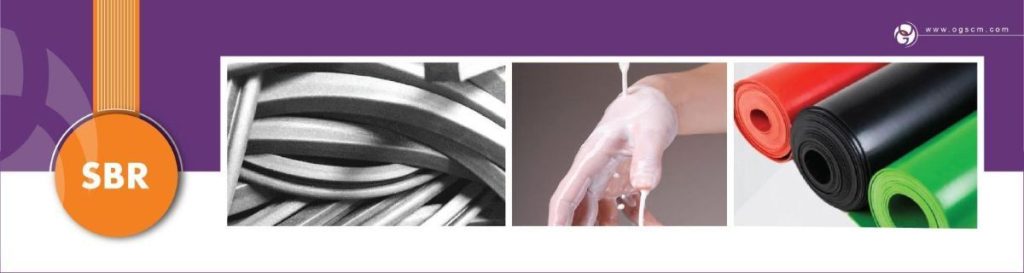
Styrene-Butadiene Rubber (SBR) is a copolymer of styrene and butadiene, produced by emulsion polymerization. The unique structure of SBR provides a balance of resilience, wear resistance, and flexibility. It is commonly used in tire treads and other rubber products, thanks to its durability and cost-effectiveness. SBR can be formulated in various grades, including high-performance and high-resilience types, depending on the specific requirements of the application.
This material is produced in two main polymerization methods:
Emulsion SBR (E-SBR): Made using emulsion polymerization.
Solution SBR (S-SBR): Made using solution polymerization (has better properties for car tires).
Applications: Car tires, flooring, belts, gaskets and industrial parts. This rubber has good resistance to abrasion and cracking, but is weak against oils.
High Cis (Hicis) Polybutadiene Rubber:
This type refers to polybutadiene rubber with a high percentage of cis-1,4 structure. The high percentage of cis structure results in greater flexibility, better wear resistance and higher dynamic properties.
High cis BR is mostly used for applications that require high impact and abrasion resistance.
Commonly used in car tires, sports balls, and shock absorbing parts.
Low Cis (Lowcis) Polybutadiene Rubber: This grade has a lower percentage of cis-1,4 structure and a higher percentage of trans or vinyl structure. Its physical properties are poorer than High Cis, but may be useful in certain applications, such as where greater stiffness or stability at certain temperatures is required.
Technical Characteristics
| Molecular formula | (C₈H₈) ·(C₄H₆)ₙ |
| Density (gr/cm3) | 0.92 – 0.95 |
| Glass transition temperature (Tg) | ~–50°C |
| Tensile strength | 12 – 25 (MPa) |
| Elongation at break: | 400 – 600% |
| Hardness (Shore A) | ~50 – 70 |
| Appearance | Black or brownish rubber, typically in solid form |
Available Grades
| SBR |
| SBR 1502 |
| SBR 1712 |
Applications
- Tire manufacturing (especially treads)
- Conveyor belts and industrial hoses
- Automotive parts (seals, gaskets)
- Footwear soles
- Vibration dampers and shock absorbers
- Rubber mats and flooring
Environmental Impact of SBR
SBR is non-biodegradable, and its production relies on petrochemicals. While it is durable and long-lasting, improper disposal can lead to environmental pollution. Recycling of SBR is possible, though it is challenging due to its crosslinked structure. Efforts to improve recycling processes and reduce dependency on virgin rubber are ongoing, with research into more sustainable alternatives.
Safety Measures and Regulations for Handling SBR
SBR is generally safe to handle but should be processed under controlled conditions to avoid overheating, which can release harmful fumes. Adequate ventilation, PPE, and compliance with safety standards (OSHA, EPA) are critical to ensuring safe production, storage, and handling.
Packing
SBR is typically supplied in bales or rolls, weighing 25, and is available in various grades for different applications.